Showing posts with label Online Advertising. Show all posts

Saturday, December 29, 2012

Plus ça change

As the irresistible machine of competitive pressures trundles on, it is no surprise that retailers are scrambling to shore up the weaknesses that they perceive in their rearguard action against the rise of the e-tailer, no matter how suspect the financial metrics of the new measures, be they same-day delivery, the ever-advancing Christmas sale season or technology-augmented shopping.


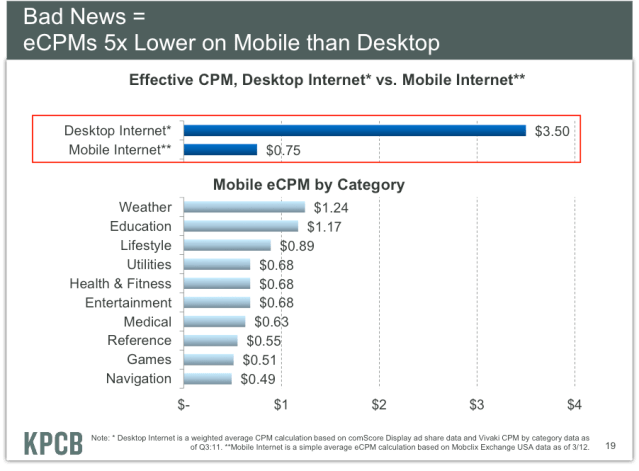
It is also no surprise that as the mobile platform is increasing eating into the media consumption mix, both marketers and media platforms are grappling with its baffling economics, even as they well be on the way to cooking their own golden goose.


Thursday, December 6, 2012

Engaging business

Customer engagement has been the Holy Grail of marketers ever since they figured out that Web 2.0 and mobile technologies let them reach their targets one-on-one and where they are.

However, as Steve Olenski capably points out, consumers have other ideas. There was a time when engagement meant listening to what the consumer had to say. Perhaps the time has come to resurrect this increasingly quaint notion.

Monday, December 3, 2012

Ad technology meets reality, part 5876

In news surprising only to marketers, advertising entrepreneurs, and their VC backers, consumers would rather avoid location-based intrusion.Once again, technology gets far ahead of actual demand.

Tuesday, November 20, 2012

Twitter responds (sort of and in deed)

As Dalton Caldwell has also noticed, Twitter is repositioning itself as a few-to-many information delivery platform: perfect for getting out brand messaging and less focused on many-to-many microblogging.


As I have already argued, this is an inevitable and -- for Twitter's finances -- necessary move. Now, if its management team would recall that undermining partner ecosystems is not a certain way to riches but rather focus on charging tolls on the value it does deliver.

Friday, November 16, 2012

The emperor of social media and his new clothes

As AdAge is finally pointing out what should have been blindingly obvious, No amount of "Liking" or "Friending" means a thing for a brand unless it ultimately translates into actual sales. New media, much like the old, is a channel for communicating a message.


If the message is not seen, ignored or lost in the clutter then all the efforts at "engagement" are no more useful than the proverbial other half of advertising.


Saturday, November 10, 2012

Circular advertising grows up

It was inevitable that the familiar circular ad from your local retailer would find its way onto the Web -- we just did not know the form that it would take.

The verdict is beginning to come in now, and Facebook is the early leader, taking away one more source of revenue for newspapers and bulk mailers and digitalizing yet another aspect of the purchasing experience.

Without a doubt, bringing circulars into the social media environment creates a richer viral platform for the brick-and-mortar retailers. Still, online competition is not sleeping at the wheel, and we should expect them to respond by aggressive advertising placed near and around the store ads. Let the games begin.

Friday, November 9, 2012

The ecstasy and the agony of Twitter


Now that the drama of the election is over, at least one thing has been made abundantly clear: Twitter has once again demonstrated its immense value as a promotional vehicle.


The reason for Twitter’s dominance, it seems to me, is its fundamental design, where all content delivered to a subscriber always comes because the subscriber has explicitly opted in to receive it – wither directly from the source or by way of a trusted intermediary. This is where the secret to Twitter’s success in driving consumer behavior really lies and this is the reason that it will always outperform its online competition.

However, it seems that Twitter’s recent moves toward monetization are threatening the very nature of its value-add. First, it burned developers who have done a great deal to help Twitter gain acceptance and made it usable for volume communications. More recently, Twitter began inserting ads into the tweet-stream, which goes directly to undermining the relationship of the subscriber to the information source. The subscriber no longer receives only the information that he or she has opted in to read, but is now bombarded with what amounts to, not to put a finer point to it, spam. Spam, as we all know, is uninvited and unwelcome messaging. There is a largish cottage industry that grew up around defeating spam for email, but Twitter is a walled garden and it will make sure that spam from its advertisers always gets through.

Now, this is not to say that Twitter does not need to monetize its offering, quite the contrary. Without a viable monetization strategy, the company is just as likely to go the way of Netscape (remember them?) as the more recent New Media failures. Still, forcing a steady diet of spam down the throats of its subscribers is rather more likely than not to create an opening for a new entrant poised to eat Twitter’s lunch, because there are few things that people hate as much as they do spam. There are some rather obvious monetization strategies that Twitter does not seem to have pursued in its quest for financial viability. For the sake of its shareholders, not less than for the sake of its advertisers, I hope that Twitter figures out that killing the goose sooner or later will put an end to golden-egg flow.

(Wired article link hat tip: Abnormal Returns)